
The White House has urged India and its other allies and friends to help isolate Iran and put pressure on the Iranian regime to give up its nuclear weapons ambitions.
Plans have been drawn up for dealing with worst-case scenarios in Pakistan, NBC news reported quoting current and former US officials, who say that ensuring security of Pakistan's nuclear weapons has long been a high US security priority even before 9/11 terrorist attacks.

Defence Minister Manohar Parrikar on Thursday dismissed his Pakistani counterpart Khawaja Asif's statement on use of nuclear weapons.

'The touchstone is reciprocity which will be applied to friends and foes alike.' 'It will be a bitter pill to swallow.'

The extended range of the missile which is part of the Strategic Forces Command will give a variety of options to the planners during times of conflict.
Narayanan sought to allay apprehensions on threat posed by Pakistan's nuclear arsenal to India and said that the government has a contingency plan in place to deal with such a situation.
The latest cache of WikiLeaks lays bare the deep concern of the US over the safety of Pakistan's nuclear weapons and the fact that Islamabad is producing them at a "faster rate than any other country in the world".
Painting a damning picture of its "ally", American officials expressed serious misgivings about the possibility of elements within the Pakistan establishment smuggling enough material out to eventually make a rogue nuclear weapon. The Pakistan-focussed cache of US embassy cables published by The Guardian reveal American and British diplomats fear that Pakistan's nuclear weapons programme could lead to fissile material falling into the hands of terrorists.
"Pakistan wouldn't have acquired nuclear weapons if it hadn't have been for Chinese assistance," Senator Jim Webb, said on Monday at the Council on Foreign Relations, a Washington-based think tank.
Israel has told the US to keep a military strike option open to stop Iran from developing nuclear weapons, a suggestion rejected by Washington. Israeli Prime Minister Benjamin Netanyahu made the suggestion reportedly to the US Vice President Joe Biden during talks in New Orleans on Sunday.

The 193-member General Assembly adopted the draft resolution, put forward by Ukraine and its supporters, titled 'Principles of the Charter of the United Nations underlying a comprehensive, just and lasting peace in Ukraine'.

The Indo-Japanese nuclear deal may not come easy considering India's Civil Nuclear Liability Act provisions which had earlier put off suppliers like General Electric, says Debalina Ghoshal.

Oppenheimer is a very politically significant film for our time, observes Utkarsh Mishra.

The news about him seeking an increase in nuclear arsenal is false, he said.
The United States and the United Kingdom on Sunday said they are confident about Pakistan's control over its nuclear weapons despite an 'increasing threat' to its authority from terrorists, a day after Taliban militants carried out an audacious attack on the Army Headquarters in Rawalpindi.

Peskov said, 'main goals of the operation' are to 'get rid of the military potential of Ukraine', to ensure Ukraine is a 'neutral country', to get rid of 'nationalist battalions', for Ukraine to accept that Crimea is a part of Russia and accept the breakaway regions of Luhansk and Donetsk.
'Satellite photos of Pakistan's Khushab nuclear site show what appears to be a partially completed heavy-water reactor capable of producing enough plutonium for 40 to 50 nuclear weapons a year, a 20-fold increase from its current capabilities.'
On Russia-Pakistan relations, he said that the Russian foreign policy was fully focused on India preventing the raising of bilateral relations to a new level.
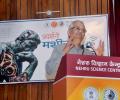
'Why should we disclose classified information to satisfy those who doubt our Hydrogen Bomb capability?'

It's intriguing that the prime minister now wants his American partner to help protect the Hindu minority in Bangladesh. That's conceding to the Americans a pre-eminence India has always contested, resented and feared, asserts Shekhar Gupta.
Pakistan believes that nuclear weapons are its "crown jewels" and a deterrent against India, a top US military official has said, even as he expressed deep concern over the safety of the nukes in the country. "These (nuclear weapons) are their crown jewels," Admiral Mike Mullen Chairman of the Joint Chiefs of Staff said.
Noting that proliferation of nuclear weapons with links across regions has affected its own security, India on Tuesday asked the international community to pay greater attention to such dangers in the backdrop of North Korean atomic test.

'Trump forgets that Kim is not one who likes to be treated publicly as a pauper; he wants to come to the table as an equal, and from a position of perceived strength, not as a suppliant,' says Dr Rajaram Panda.
Prime Minister Manmohan Singh on Wednesday revealed that he had told United States President Barack Obama that India does not favour Iran's nuclear weapons ambitions but sanctions were not an answer as poor people get more affected by them."I said to the President that we do not favour Iran's nuclear weapons ambitions," Dr Singh told a press conference in Washington, when asked about the discussions on Iran that he had with Obama two days ago.

Russia's unprecedented rapprochement with North Korea has raised concerns about the re-emergence of a Russia-China-North Korea alliance which could increase the probability of conflict on the Korean Peninsula, explains Dr Rajaram Panda.
Counting many elements, including terrorism and nuclear weapons, in Pakistan as causes of international worries, a former top United States official has described the South Asian country as an 'international migraine'. "So, I think that the current president and the current secretary of state, who's on her way to India right now, have a very big job ahead of them," said former secretary of state Madeleine Albright.

US President-elect Barack Obama on Saturday said Iran's development of nuclear weapons was "unacceptable" and sought a concerted effort by the international community to address the controversial issue.
Cheney said that the US was working with it allies to persuade Iran to give up its nuclear weapons programmes, and that it was Washington's preference for that to happen peacefully.
External Affairs Minister Pranab Mukherjee said India's participation in a new global consensus on non-proliferation would strengthen global efforts in this arena.

Air Chief Marshal said his force is ready for a full spectrum operation but added that any decision on surgical strike involving the IAF has to be taken by the government.
The state electoral rolls can be revised only by the end of January, he told NDTV 24X7.
IAEA, chief share Nobel Peace prize for efforts to spread non-proliferation of nuclear arms.

With the spectre of nuclear terrorism growing, the international community is concerned about the security of India's nuclear facilities. The worry has grown since 2010, when radioactive Cobalt-60 surfaced in a New Delhi scrapyard, killing one person and hospitalising eight others.

The Musharraf episode in the recent history of the subcontinent has convinced many realists in India that the hope of establishing peace with Pakistan is like accepting a dinner invitation from cannibals and expecting to live to tell the tale, points out Colonel Anil A Athale (retd).
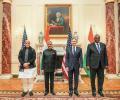
The Biden administration has reaffirmed its commitment to support India's permanent membership in a reformed UN Security Council and New Delhi's entry to the Nuclear Suppliers' Group.
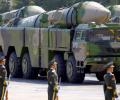
The 119 nearly identical construction sites, that could potentially house powerful weapons capable of reaching the American mainland, are similar to those seen at existing launch facilities for China's arsenal of nuclear-tipped ballistic missiles, the report said.

The country's sixth nuclear test sparked a powerful 6.3 magnitude earthquake which was detected in the northeast of the country where North Korea's test site Punggye-ri is located.
Clinton was asked what she would do if Iran attacked Israel with nuclear weapons in an interview on ABC's Good Morning America programme, Ynetnews reported. "I want the Iranians to know that if I'm the President, we will attack Iran," she replied, adding, "In the next 10 years, during which they might foolishly consider launching an attack on Israel, we would be able to totally obliterate them."
